16. Git stats, part 3: goals you can actually check
"Grow as an engineer" is not a goal. A goal needs a start number, a direction and a check date. How to use your git history to set goals you can check every month.
This post shows how to use your git numbers to set goals.
It’s January. Your manager asks for your goals. You write:
- Grow technically.
- Improve code quality.
- Be a better team player.
Your manager says “great”. A year later you read the list again. Did you do it? Nobody knows. There was nothing to check.
Part 1 was about the past. Part 2 was about problems now. This part is about the future. Most goals have no start number, so nobody can check them. Your git history gives you the start number for free.
The problem
A goal you can check has three parts:
- Baseline. Where you are today, as a number.
- Direction. Which way it moves, and about how far.
- Check date. When you look again. Every month is best.
No baseline: you can’t see progress. No check date: you see it too late.
“Improve code quality” has none of them. “Median PR size from 212 lines to under 150 by June, check every month” has all three.
The number is not the point. The point is that in March you both know if it works.
A warning first
In the performance series I quoted Goodhart’s law: when a number becomes a target, it stops working.
“Merge 150 PRs this year” is a bad goal. You split work into tiny PRs. The count goes up. Nothing gets better.
So the rule: pick a habit, not an output.
- PR size is a habit.
- Review speed is a habit.
- PR count is output.
Habits are hard to fake. Good habits give good output on their own.
And keep one goal with no git number. More on that at the end.
The screenshots come from ShowOffer, a tool I built. All data is made up.
Step 1: find your shape
First see what kind of engineer you are now. Not what you think. What the data shows.
The contribution profile puts six numbers on one radar: PRs, reviews, issues, commits, repos, longest streak. The dashed line is the last period.
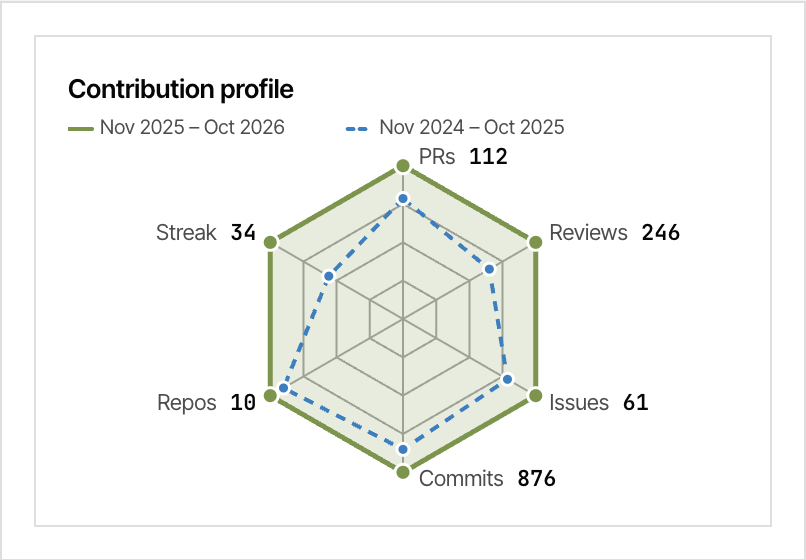
Don’t look at the size. Look at the shape. Compare the solid line with the dashed one:
- Reviews and streak grew the most. This engineer became a reviewer this year. On purpose?
- Repos and commits did not move. Same codebase. Same scope.
Now you have a real choice: grow your strong side, or fix a weak one. Both are fine. Choose on purpose.
Check your career ladder. Most ladders reward bigger scope, not more output. For the next level, “repos did not move” can matter more than “reviews went up”.
Step 2: get the baseline
Take the last 3 or 6 months. A full year mixes in old habits. One month is too noisy.
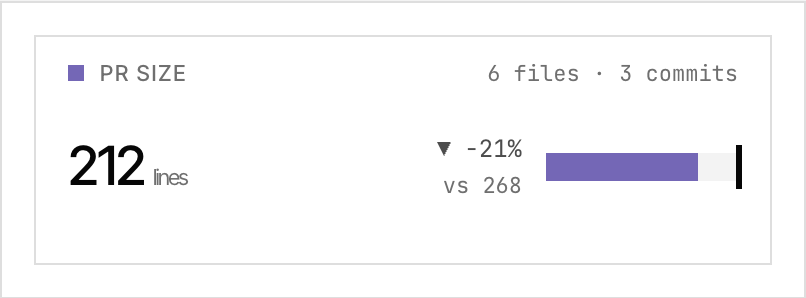
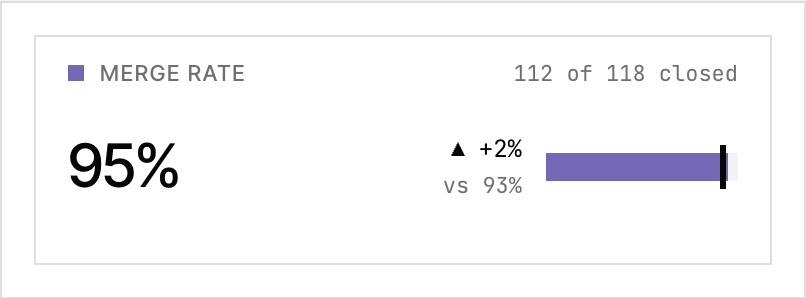
Write the baseline down, with dates. For example: “Nov 2025 to Oct 2026: median PR size 212 lines, merge rate 95%.” You will need this line in a year.
Step 3: pick the goal
Goals I like. Each has a number, and each is hard to game:
| Goal | Number | Why it’s a habit |
|---|---|---|
| Smaller PRs | Median PR size | Faster, better reviews. Tiny fake PRs make review harder |
| Faster reviews | Review response time | How long others wait for you. Can’t fake it without reviewing |
| Fewer dropped PRs | Merge rate | Less wasted work, clearer plans |
| Wider scope | Repos touched | What most ladders ask for at the next level |
| Steady pace | Consistency score | No crunch months, no dead months |
| Unblock others | Reviews per own PR | Your share of team reviews. Grow it only if your work allows |
Pick one or two. Not six. Each goal costs attention.
Write the reason next to the number. “Smaller PRs, so reviewers give real feedback” is a goal. “PR size under 150” alone is a target to game.
Step 4: check every month
A goal you check once a year is a wish. A goal you check every month is a plan.
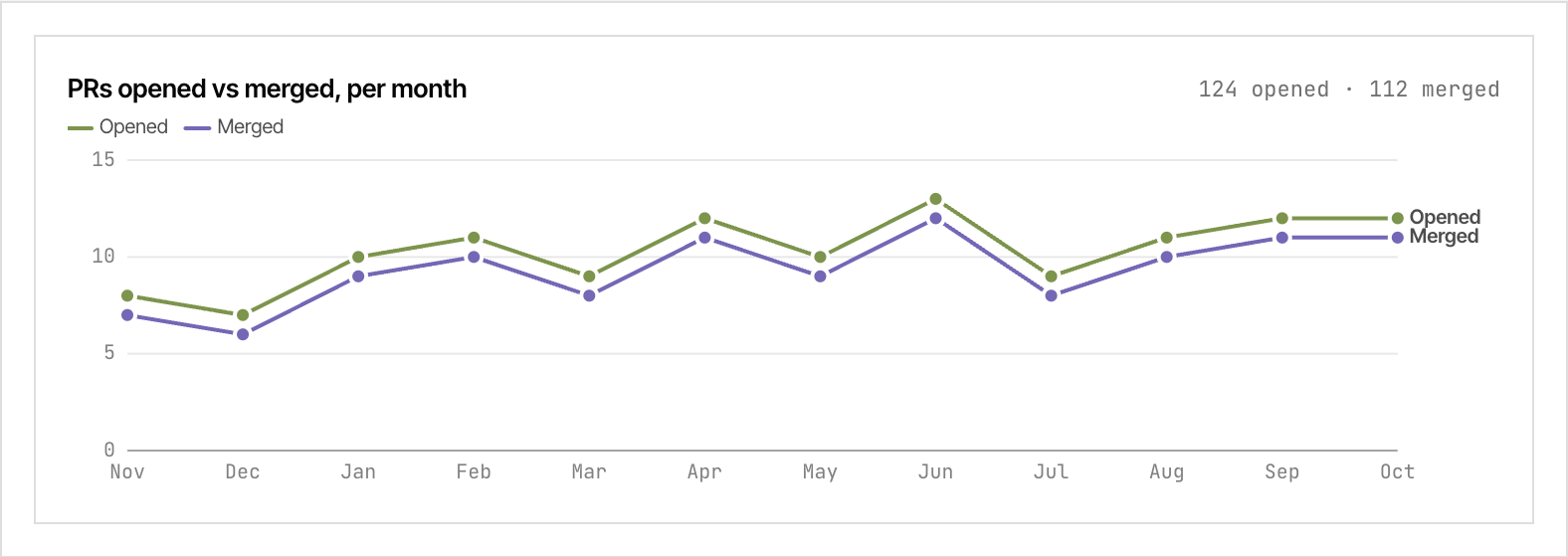
Watch the gap between opened and merged:
- Small, steady gap. Work flows.
- Growing gap. PRs pile up. Too much work at once, or slow reviews.
Here the lines stay close all year. Healthy.
For “steady pace”, use the consistency score:
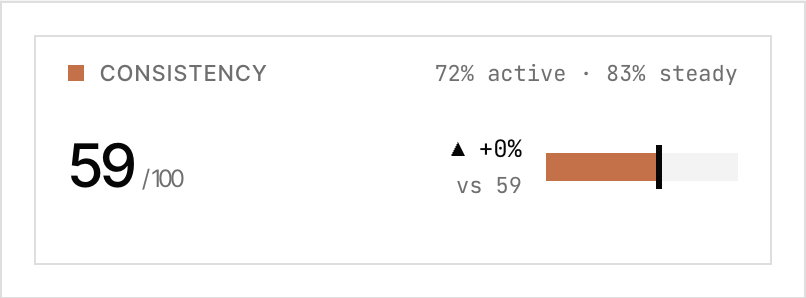
Score = active days × how steady the months are. 72% × 83% ≈ 59. A crunch month and then a dead month pull it down.
One trap: more active days also raise the score. Don’t chase it with weekend work. That is the burnout case from part 2. Watch the “steady” part, not the “active” part.
You don’t need a high score. You need a score that stays flat while you work on your main goal. PR size goes down, consistency stays the same: the new habit didn’t break your rhythm.
Step 5: grow the scope
For the next level, scope is often the real test. “Owns one service” becomes “works across several”.
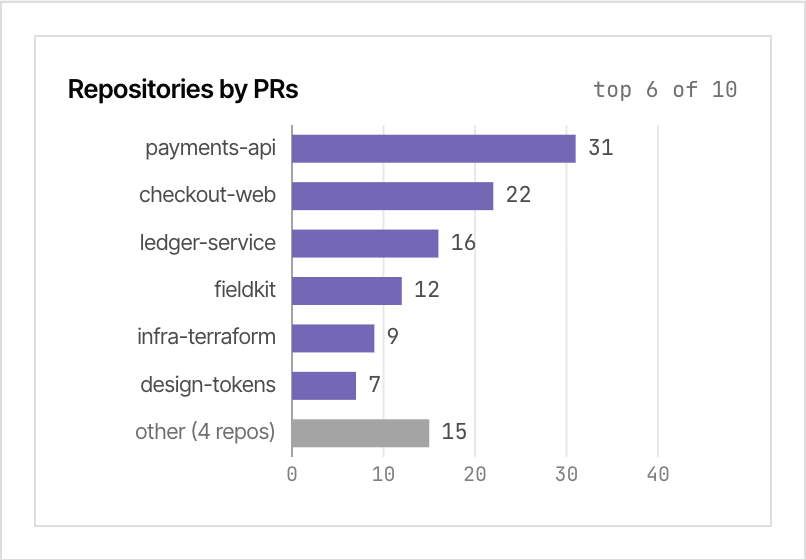
Ten repos, but most work is in the top three. Normal. A scope goal:
“Grow in infra-terraform. From 9 PRs to about 20, and run one design review there.”
Look at the second half. A PR count is weak proof of scope. A design review, a migration or an on-call week is strong proof. The number tracks the habit. The event proves the growth.
The goal with no number
Git doesn’t see everything. Keep one goal from your ladder that git can’t see:
- Lead one design review across two teams.
- Mentor a new hire through the first month.
- Write the postmortem for the next big incident.
- Run planning for one project.
The check is yes or no, plus one line. Did it happen? What did you learn?
At review time you have both: numbers that show your habits changed, and events that show you grew. That is the self-review from part 1, written in advance.
Ten minutes every month
I do this on the first Monday of each month:
- Open the report generator. Pick the period since your goals started. Turn on compare with the previous period.
- Keep only the widgets for your goals: PR size, merge rate, profile, opened vs merged.
- Download one PNG. Put it in your goal doc under the month.
- Write one line: on track or off track, and why.
- Bring the line to your next 1:1.
After a few months the goal doc tells the story: baseline, steps, result. Your manager saw every step. No surprises at review time.
It runs in your browser. No back end, no sign-up. The token stays in memory and goes only to api.github.com. It reads stats, never your code.
The series
| Part | Problem | What git gives you |
|---|---|---|
| 1. Review | You forget most of the year | A dated record |
| 2. 1:1 | Process problems stay hidden | A number instead of a feeling |
| 3. Goals | Goals have no start number | A baseline and a monthly check |
Note
All engineers and numbers in the images are made up. I built ShowOffer, so I am not neutral. The method works with any numbers: GitHub search, team dashboards, a spreadsheet.
These numbers don’t measure your value. They measure habits. Pick habits that make you better at the job you want.
GitHub · LinkedIn · Dev.to · Substack · 4thwithme.dev/blog
May the --force be with you.